This article is based on an episode of The Adventure Story Podcast, where I chase legends, uncover history, and ask the questions that mainstream people sometimes choose to ignore. You can find the intro below, or wherever you get your podcasts.
Did the Ancient Khmer Know About Dinosaurs?
Carved into the wall of an 800-year-old Cambodian temple is an image that shouldn’t exist. It shows an animal with a distinctive row of plates running along its back — remarkably similar to the way we picture a stegosaurus today. The temple is Ta Prohm, built in the late 12th century. The stegosaurus, according to science, went extinct approximately 145 million years ago.
So what exactly are we looking at?
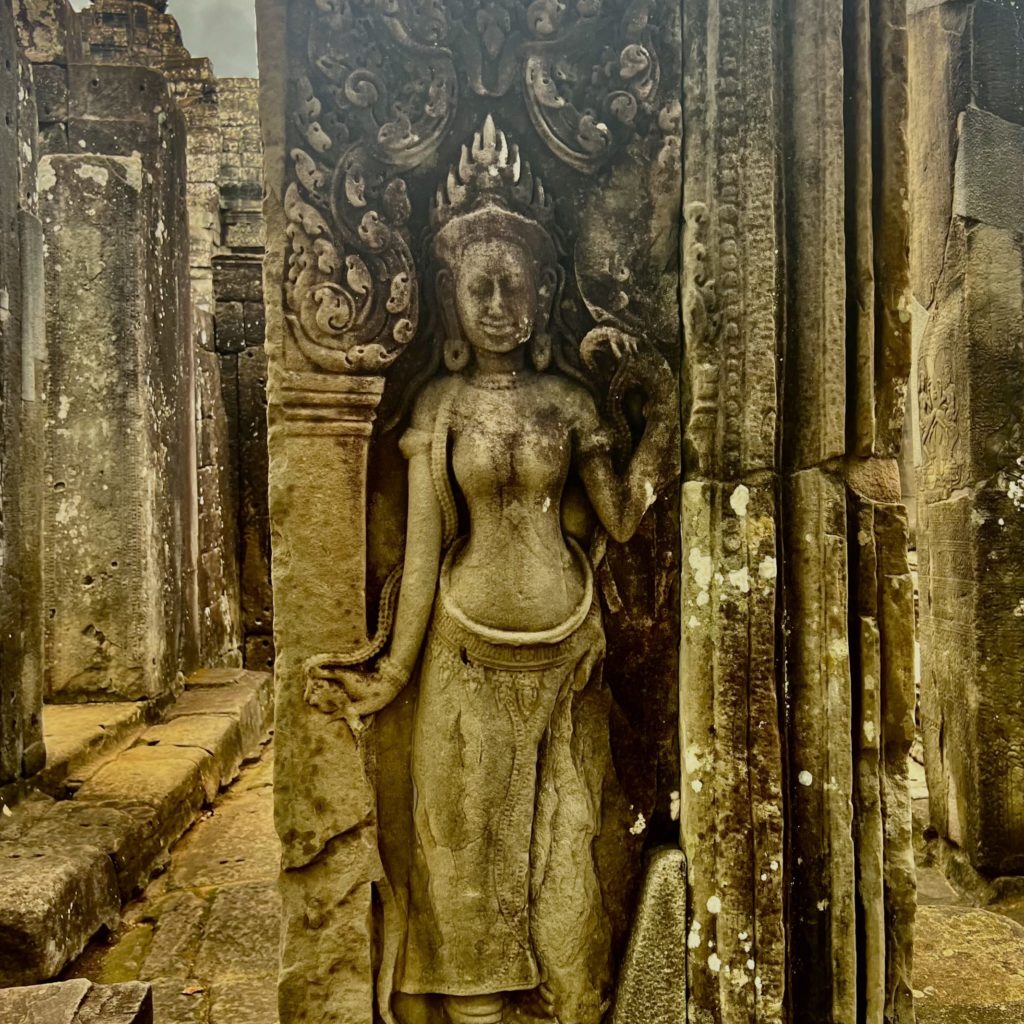
I saw this carving with my own eyes when Mrs R and I visited Cambodia in 2024, researching what would become my novel The Lotus Key. Ta Prohm is already one of the most extraordinary places I have ever visited — a Buddhist monastery left in a state of deliberate wildness, its ancient stones wrapped in the roots of enormous trees, every inch of its walls covered in intricate carvings. Among all of those carvings, one in particular stopped me in my tracks.

The Carving That Divides Opinion
The standard dismissal goes something like this: it’s a poorly executed carving of a boar or a rhinoceros, with background foliage creating the illusion of plates along its back. The head, say the sceptics, is more pig-shaped than dinosaur-shaped, and the plates aren’t clearly attached to the animal’s body.
I was there. I don’t think so.
Here is what strikes me about that explanation. The craftsmanship throughout Ta Prohm is exceptional. The Khmer Empire was renowned for its artistic precision — these walls were not decorated by amateurs. The temple is covered in carvings of recognisable local animals, all executed with confident, expert hands. To suggest that the same craftsmen who produced thousands of detailed, accurate depictions of real animals suddenly produced one sloppy, ambiguous image of a common pig seems, to put it gently, convenient.
The carving isn’t hidden away in a dark corner either. It sits on a major wall, surrounded by other clearly identifiable species. These artists knew exactly what they were doing. The question is what they were depicting.
The Theories
There are broadly three ways of explaining the carving, each with its own merits and problems.
The first is the most dramatic: that a small population of stegosaurus survived in the dense Cambodian jungle until comparatively recent times, and that the Khmer people had actually seen one. This sounds far-fetched, and it probably is — but it’s worth remembering that science occasionally gets these things wrong. The coelacanth, a prehistoric fish believed to have been extinct for 66 million years, was found alive and well in 1938. We are still discovering new species today. The argument that something definitely no longer exists is always slightly weaker than it sounds.
The second theory is more plausible: that the Khmer people discovered dinosaur fossils and, with impressive scientific intuition, reconstructed what the living animal might have looked like. This wouldn’t be without precedent — there’s a credible argument that ancient Chinese descriptions of dragons were influenced by the discovery of dinosaur bones. A civilisation as sophisticated as the Khmer Empire, with the intellectual resources of a major university at Ta Prohm, is entirely capable of that kind of deductive reasoning.
The third theory is the sceptic’s position: it’s a misidentified animal, the plates are background vegetation, and we’re seeing what we want to see. Which would be more convincing if the carving weren’t quite so specific, and if Ta Prohm weren’t quite so full of other carefully observed, accurately rendered creatures.

Ta Prohm’s Other Secrets
The stegosaurus carving is not the only mystery hiding within Ta Prohm’s walls. The temple is also known for its magic squares — grids of numbers that add up to the same total in every direction, a kind of ancient mathematical puzzle that some researchers believe may encode knowledge that has since been lost. In 1935, French archaeologist Henri Marchal documented finding sealed vaults during restoration work that were never fully explored, and which some historians believe may contain sacred Buddhist texts or royal treasures from the Khmer Empire. Ground-penetrating radar surveys have detected anomalies beneath the temple that could indicate hidden chambers, but no full excavation has been approved. Like so much about Ta Prohm, these underground secrets remain tantalisingly out of reach.
It Doesn’t End in Cambodia
What makes the Ta Prohm carving harder to dismiss is that it is far from unique. In Acambaro, Mexico, over 33,000 ceramic figurines were discovered in 1944, among them detailed dinosaur sculptures that correspond surprisingly well to our modern understanding of how those animals appeared. In Peru, thousands of carved Ica Stones depict what appear to be humans living and hunting alongside dinosaurs. In Utah, petroglyphs at Natural Bridges National Monument show a figure that some researchers identify as a dinosaur, though sceptics prefer the word lizard. And closer to home, a brass etching from 1496 in Carlisle Cathedral shows a creature that some argue is a dinosaur and others a medieval dragon — with anatomical details that are surprisingly accurate for something supposedly imagined from scratch.
Each of these individually can be explained away. Taken together, across different continents, different cultures, and different centuries, they form a pattern that is at least worth sitting with for a moment.

A Question Worth Asking
I want to be clear that I am not claiming dinosaurs roamed the Cambodian jungle in the 12th century. But I am saying that the carving at Ta Prohm deserves a better answer than the one it usually gets. The Khmer craftsmen who built that temple were among the most skilled artists of the ancient world. They paid attention. They were precise. And on one wall, among thousands of carefully observed creatures, they carved something with a row of plates along its back.
Maybe they found a fossil. Maybe they saw something. Maybe it is a very unusual pig. But if you ever find yourself at Ta Prohm — and I hope you do, because it is one of the most remarkable places on earth — stand in front of that carving and decide for yourself.
The carving at Ta Prohm was one of the sparks that helped shape my novel The Lotus Key. Deep within Cambodia’s Angkor Wat, a millennia-old secret is waiting to be unleashed — a long-lost relic called the Lotus Key, with the power to control millions of minds. Its promise is absolute peace. Its cost is the death of free will itself. Eden Black and her team are thrust into a deadly race across the Cambodian jungle, battling Khmer Rouge minefields, ancient traps, and ruthless mercenaries, all to stop the Lotus Key from falling into the wrong hands. If standing in front of that stegosaurus carving and wondering what else the ancient world knew has sparked something in you, The Lotus Key is where that wondering leads. It is available now in ebook and paperback wherever you get your books.
A Note on Cambodia’s Landmines
During our visit to Cambodia, Mrs R and I visited an exhibition on the landmines that continue to affect the country’s poorest communities — a legacy of decades of conflict. We were so moved by what we saw that we committed to supporting the Landmine Relief Fund with a monthly donation throughout 2025. The fund clears mines and works with an organisation that has built nearly 50 schools on and around former minefields, returning land to communities and investing in education. As a former teacher, that combination felt like exactly the right cause to support.
A small percentage of the money from my books, audiobooks, and subscriptions goes to this fund, so if you’ve enjoyed one of my stories, you’ve already helped. You can find out more at landmine-relief-fund.com.