This article is based on an episode of The Adventure Story Podcast, where author I chase legends, uncover lost history, and ask the questions that a lot of people like to ignore. You can find the full episode wherever you get your podcasts.
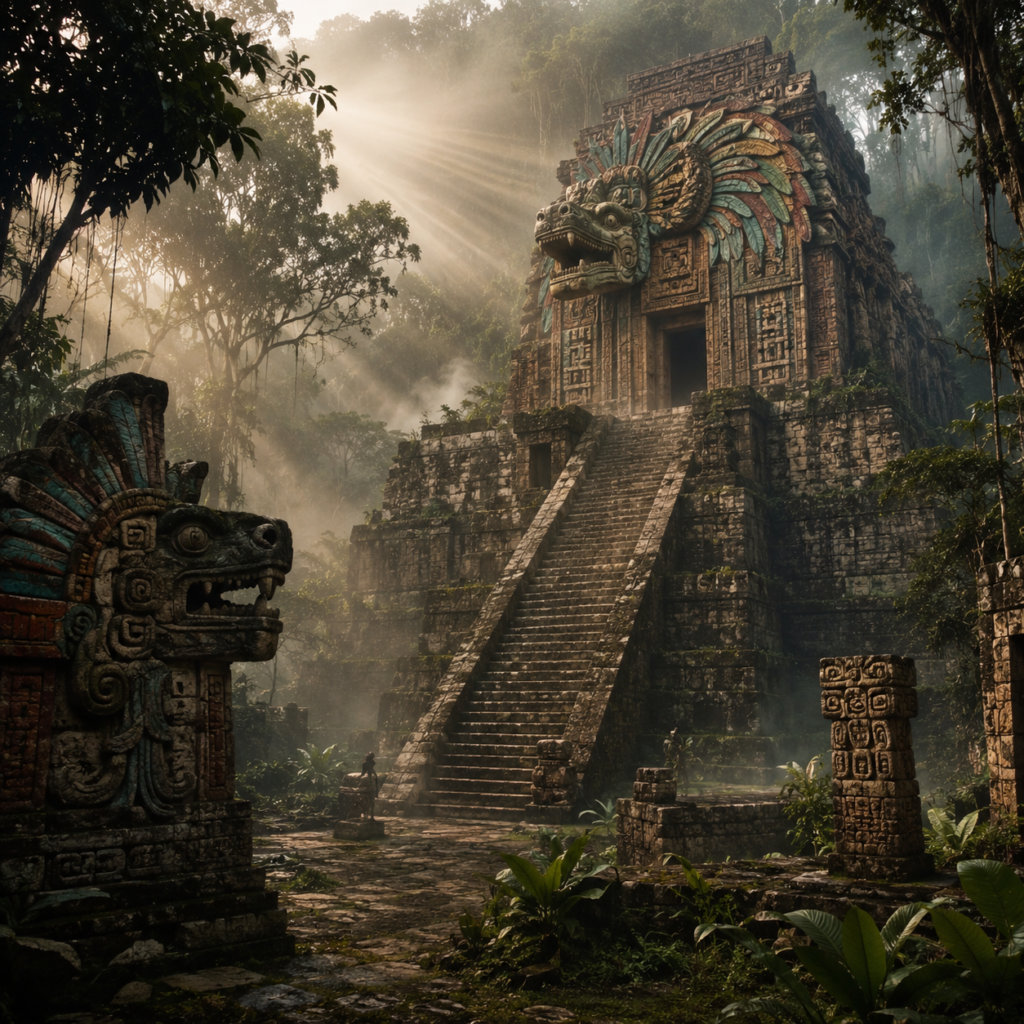
It’s 1924 in the ancient Mayan city of Lubaantun. The ruins rise from the Belizean jungle like stone ships in a green ocean. Seventeen-year-old Anna Mitchell Hedges is helping with her adoptive father’s archaeological dig — probably wondering, as teenagers do, why expeditions always involved quite so many bugs and quite so little air conditioning.
The team has been clearing debris from beneath a collapsed altar all morning before breaking for lunch. Anna stays behind. Maybe she’s being a stubborn teenager, or maybe she simply knows that something extraordinary is about to happen.
She picks through the rubble with her feet when the ground shifts beneath her. Before she can call out or grab hold of anything, the floor gives way entirely, and Anna plunges down through the darkness — a heartbeat of terror — before landing hard on packed earth about fifteen feet below.
As the dust settles and her eyes adjust to the gloom, she realises she’s in some kind of ceremonial chamber. Rays of sunlight pierce the hole above, dancing across ancient walls covered in worn Mayan glyphs. And there, on an altar at the centre of the chamber, something catches the light and throws it back at her a thousand times brighter.
What she is looking at is too well crafted for the civilisation they’ve been excavating. It is perfect. It is a human skull, carved entirely from crystal, sunlight playing through it like liquid and casting rainbow patterns on the chamber walls. And it has a detachable jawbone — a feature unique among all known crystal skulls.

Indiana Jones Got It Right
If you’ve seen Indiana Jones and the Kingdom of the Crystal Skull, you might remember Indy muttering the name Mitchell Hedges in a diner early in the film, in a way that sounds like a throwaway piece of movie texture. It isn’t. The Mitchell Hedges skull is very real, it is genuinely one of the most debated artefacts in the world, and some people believe it has supernatural powers.
After finding the skull as a teenager, Anna Mitchell Hedges spent the rest of her life making extraordinary claims about it — claims that would not sound out of place in one of my novels. She said neighbours could see mysterious lights flickering from the room where she kept the skull. She described people being spontaneously healed after spending time near it, and others reporting vivid visions of past and future events while meditating in its presence. On certain nights, particularly during a full moon, she claimed it would emit a faint bluish glow, accompanied by a high-pitched resonance almost at the edge of human hearing. She even claimed the skull had predicted aspects of World War II, delivered to her in dreams after meditating with it.
Anna refused offers of millions of dollars to sell the skull, insisting it was a sacred object that needed to be protected. She kept it until her death in 2007 at the age of one hundred, and in her final years she spoke about its mysterious properties with the same wide-eyed wonder as that seventeen-year-old girl who allegedly found it in the ruins.
The Curious Case of F.A. Mitchell Hedges
You can’t tell this story without talking about Anna’s father — the self-styled explorer F.A. Mitchell Hedges, a man who deserves a book of his own. Born in 1882 to a wealthy London family, he spent his inheritance funding expeditions to Central America, claiming to have discovered lost cities in the Honduran jungle, hunted pirates in the Caribbean, and found evidence of Atlantis in the Bahamas. His 1931 book, The Land of Wonder and Fear, tells these tales with such breathless conviction that you almost want to believe them.
Almost. The problem is that most of his celebrated discoveries were already well documented by other explorers, and many of his adventures appear to have been, shall we say, generously embellished.
But here is the detail that really gives you pause: in that same 1931 book, Mitchell Hedges is happy to describe every extraordinary adventure he has ever had — and yet he doesn’t mention the crystal skull. Not one word, not one line, despite the fact that his daughter supposedly discovered it three years earlier. For a man who never undersold a story in his life, the omission is a strange one.
The Mystery That Remains
Even if you set aside every supernatural claim and dismiss the whole affair as creative fiction — and there is nothing wrong with creative fiction — one genuine mystery remains. Nobody has been able to fully explain how the skull was made.
It is carved from a single piece of extraordinarily pure quartz, and the craftsmanship is remarkable by any standard, including modern ones. The detachable jawbone alone represents a level of precision that would challenge contemporary crystal carvers. Whether it is an ancient Mayan artefact, a masterpiece of Victorian craftsmanship, or an elaborate hoax, the technical question of how it was produced has never been satisfactorily answered.
Where is the Skull Now?
After Anna’s death in 2007, the skull passed to her widower, Bill Homan, who continues to tour with it and allows people to experience its alleged properties for themselves. It travels in a custom-made wooden box lined with purple velvet, still catching the light just as it apparently did in that jungle chamber a century ago. Homan has added his own chapter to the legend, claiming to have witnessed the skull glow blue during a total solar eclipse in Mexico.
Whether it is a sacred Mayan relic, an unsolvable technical puzzle, or one of history’s more successful cons, the Mitchell Hedges skull has an undeniable power — not perhaps a supernatural one, but the very human power of making us ask what if… and sometimes, that is more than enough.
The Mitchell Hedges skull — and the broader question of what ancient civilisations were truly capable of — was one of the sparks that helped ignite my novel The Atlantis Agenda. When an orb is discovered in the ruins of an ancient Mexican city, its strange markings point to a civilisation older than anything previously recorded. Could it be a relic of Atlantis itself? Before anyone can find out, the orb and the entire team of archaeologists responsible for its discovery vanish without a trace. It’s the kind of story that begins exactly where the Mitchell Hedges skull leaves off — with an artefact that shouldn’t exist, a mystery that powerful forces would rather keep buried, and the nagging question of how much the ancient world knew that we have since forgotten. If that sounds like your kind of adventure, The Atlantis Agenda is the third book in the Eden Black Archaeological Thriller Series and is available now wherever you get your books.