This article is based on an episode of The Adventure Story Podcast, where author I talk to writers, explorers, and historians about the mysteries and adventures that inspire great stories. You can find the full episode wherever you get your podcasts.
The Enigma of Cambodia’s Abandoned Pyramids with Caleb Andrew
What if the adventure novel you’re reading isn’t just fiction — but a window into one of the world’s most significant ongoing organised crime syndicates of all time?
That’s the question at the heart of The Koh Ker Conspiracy, the debut archaeological thriller by author Caleb Andrew. Set against the backdrop of Cambodia’s ancient temples and its turbulent modern history, the book weaves together a fast-paced adventure story with a very real scandal: the systematic looting of Khmer artefacts that has seen priceless pieces of Cambodia’s heritage end up in private collections and prestigious museums around the world.
I sat down with Caleb for the Adventure Story Podcast to talk about his book, his remarkable connection to Cambodia, and the mysteries he’s already planning to chase next.

A 13-Year-Old Boy in the Jungle
Caleb’s connection to Cambodia isn’t that of a writer who spent a few weeks researching a setting. When he was 13, his family left Ohio and moved to Phnom Penh — a move that, as he puts it, changed his life in every possible way.
“Living there changed my life. Learning the Cambodian language changed my life. Seeing the country develop changed my life. It ended up defining my career.”
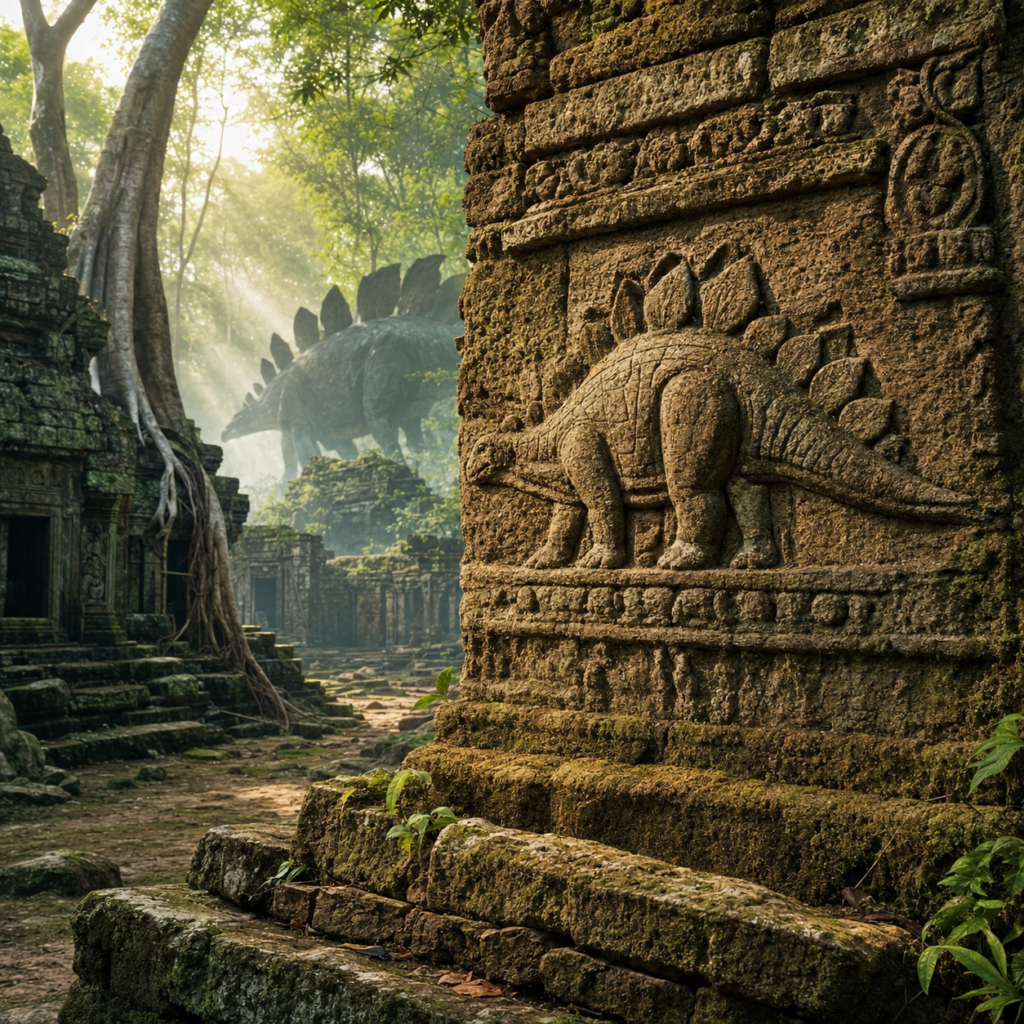
It was during those years that Caleb first visited the temple that sits at the heart of his novel: the Koh Ker pyramid, a remote and largely forgotten temple complex in the jungles of northern Cambodia. At 15, scrambling up its cracked and ancient steps, he reached the summit and looked out over an unbroken canopy of jungle in every direction.
“I feel like I was the only person for miles at this temple. The mystery, the climbing — it was a really amazing experience.”
That experience never left him. When he eventually sat down to write his first novel, he knew exactly where it would be set.
The Real Scandal of Cambodia’s Stolen Artefacts
The Koh Ker Conspiracy centres on the theft of a priceless Khmer artefact — but the fiction is built on a very real foundation. For decades, Cambodia’s political instability — the genocide of the 1970s, years of occupation, and the slow road to stability that followed — created the conditions for large-scale looting of its temples and archaeological sites.
“People really took advantage of that,” Caleb explains. “They stole things and took artefacts and moved them around the world.”
The story has a central villain: Douglas Latchford, a Bangkok-based antiquities dealer who was eventually indicted by the US Attorney in New York for his role in smuggling Khmer artefacts across the Thai border and selling them — often without proper documentation — to museums and collectors in Europe and the United States.
What makes the story stranger still is how some of these thefts were eventually discovered. One of Caleb’s favourite examples involves a wealthy American collector whose home was photographed for a magazine shoot. Readers spotted Cambodian artefacts in the background of the family portraits, which eventually led to a repatriation claim — and the artefacts were returned to Cambodia.
“Someone just looking at the magazine going, wait a minute — I think that’s from Cambodia.”
Cambodia has since launched a determined national campaign to recover its cultural heritage, working with archaeologists, lawyers, and international bodies to identify and repatriate stolen pieces. The work is far from over, but the momentum is building.

Writing About a Place You Love
One of the most interesting threads in our conversation was the question of what it means to write about a place you know deeply — and the responsibility that comes with it. Caleb was frustrated, before writing his own book, by how many novels set in Cambodia got it wrong — characters who didn’t think or act like Cambodians, history that was misrepresented or simplified, an entire country filtered through the assumptions of outsiders who had spent very little time there.
“That upset me. So I think it’s driven me to be really accurate, and also to want to highlight parts of the culture and the people that I want readers to know about and understand better.”
For what it’s worth, Caleb was generous enough to say that he felt my own Cambodia novel — The Lotus Key — handled the country well, despite my having spent only a few weeks there. Which I was quietly very pleased about.
The challenge, as both of us agreed, is that a place is never still. Cities change, neighbourhoods disappear, and the Phnom Penh Caleb knew as a teenager — including a beloved lakeside district that was filled in and demolished in 2010 — no longer exists in the same form. As a writer, there comes a point where you simply have to press the shutter button and commit to a version of a place, otherwise the book never gets finished.
What Lies at the Bottom of the Tigris?
Caleb’s sequel to The Koh Ker Conspiracy will take his characters across Southeast Asia, with Myanmar as a key setting and a fascinating lost artefact as its hook: the Great Bell of Dhammazedi. Cast in the 1400s by a monk who had become king, the bell was supposedly the largest ever made, covered in writing that no one — not even its makers — could read. For a century it hung in Shwedagon Pagoda, until a Portuguese adventurer attempted to melt it down for cannonballs, rolled it to the river, loaded it onto a raft, and promptly sank it. At an estimated 290 tonnes, this was perhaps inevitable.
The bell has never been found. Divers, government expeditions, and National Geographic teams have all searched without success, and nobody is entirely sure where it lies — the river may have shifted course, the bell may be buried deep in silt kilometres from where it went down. Caleb also mentioned a second story he’s been unable to shake: the Disaster at Kurna, involving 250 crates of Assyrian antiquities ambushed on the Tigris River in the 1850s, 150 of which were dumped into the water and never recovered. A Japanese-funded diving expedition in the 1970s found nothing, and the crates are still down there somewhere.
I know exactly the feeling he describes — reading two sentences about something and immediately thinking: I need to write about this someday.

Where to Find Caleb and His Books
The Koh Ker Conspiracy is available now on Amazon worldwide, and in paperback in the English-language bookshops of Phnom Penh — a detail Caleb is quietly proud of. If you’re heading to Cambodia and want a thriller that truly understands the country, it makes a perfect companion. You can find Caleb’s author page on Amazon, where he’ll be posting updates on the sequel and his upcoming sci-fi novel.
A Note on Cambodia’s Landmines
During our visit to Cambodia, Mrs R and I visited an exhibition on the landmines that continue to plague the country’s poorest communities — a legacy of the conflicts of the 1970s, 80s, and 90s. We were so moved by what we saw that we committed to supporting the Landmine Relief Fund with a monthly donation throughout 2025. The fund not only clears mines, but works with an organisation that has built nearly 50 schools on and around former minefields, returning land to communities and investing in the next generation. As a former teacher, that combination of safety and education felt like exactly the right cause to support.
A small percentage of the money from my books, audiobooks, and subscriptions goes to this fund, so if you’ve enjoyed one of my stories, you’ve already helped. You can find out more at landmine-relief-fund.com.
If you enjoyed this, the full conversation with Caleb is available on The Adventure Story Podcast — find it wherever you get your podcasts. And if you’d like to join the Adventure Society, my weekly newsletter covering real-world adventures, new books, and podcast updates, head to lukerichardsonauthor.com/adventuresociety.