This is the author note, which is published at the end of the book. It’s my chance to pull back the curtain a little and tell you what parts of the story are true, and where I’ve taken dramatic liberties. As a world traveller, I love bringing real places, cultures and history into my stories, and I feel it would be a mistake not to share the truth with you.
Be aware, there are spoilers here! I’d suggest you don’t read this until you’ve finished the book.
Order your copy of the book here.
And there we are, Eden’s sixth adventure comes to an end. Thank you so much for joining me. It’s wonderful to be able to share my stories with you!
Completing a book is always a time for reflection and a chance to look forward to the next adventure. As I write this in December 2024, it’s just a few weeks shy of six years since I started to write my first book—the story that ultimately became Kathmandu Killers.
I was working as a high school English teacher at the time, and frustrated with the lack of creativity and freedom the job offered me. When I started writing, all those years ago, I never imagined that this would turn into a job that I deeply love. By buying, reading and reviewing (hopefully!) this book, you’re helping me sustain that, so thank you very much.
As with all my stories, I aim to weave something from the setting into the narrative. Mrs. R and I visited Cambodia in July 2024 as research for this book and absolutely loved it. It’s a beautiful country with mountains, beaches and incredible temples—we’ll return for sure. At the start of our trip, we spent several days visiting the temples in the Angkor region—including the world-famous Angkor Wat. While the Lotus Key, the discs, and the hidden carving are figments of my imagination, there are large parts of this book that could be true or are my interpretation of actual events and places.
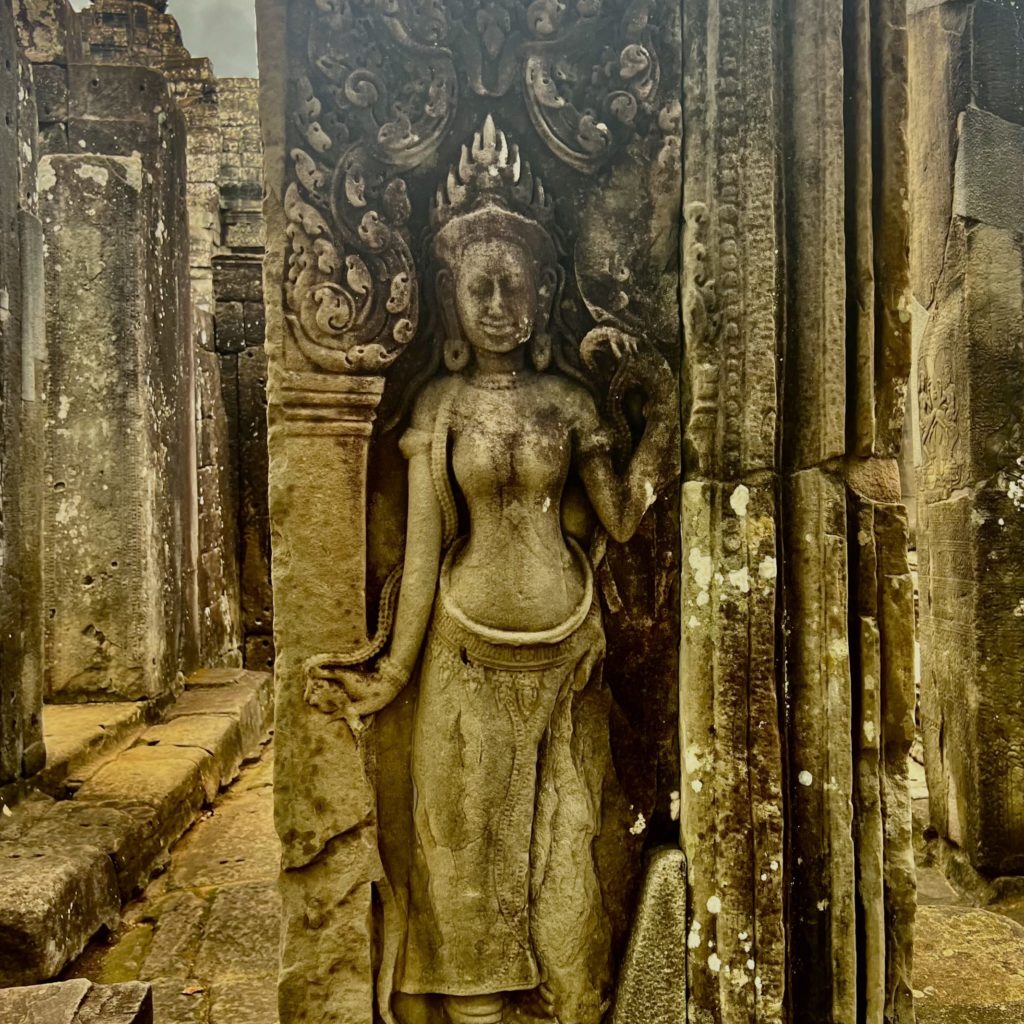
Angkor Wat, and the city of Angkor Thom are vast places, expanses of which are still covered by jungle. Scans from helicopters and even from space have shown how big the civilization was—the biggest in the world at that time. I’m certain that many secrets still lie hidden, with undiscovered sites yet to be revealed. The carvings adorning the temple walls also surely hold layers of meaning—like the great works of western writers do—but what those meanings might be is left to the imagination. Although there’s no evidence that these carvings point toward a lost and powerful relic, it’s a possibility, right?
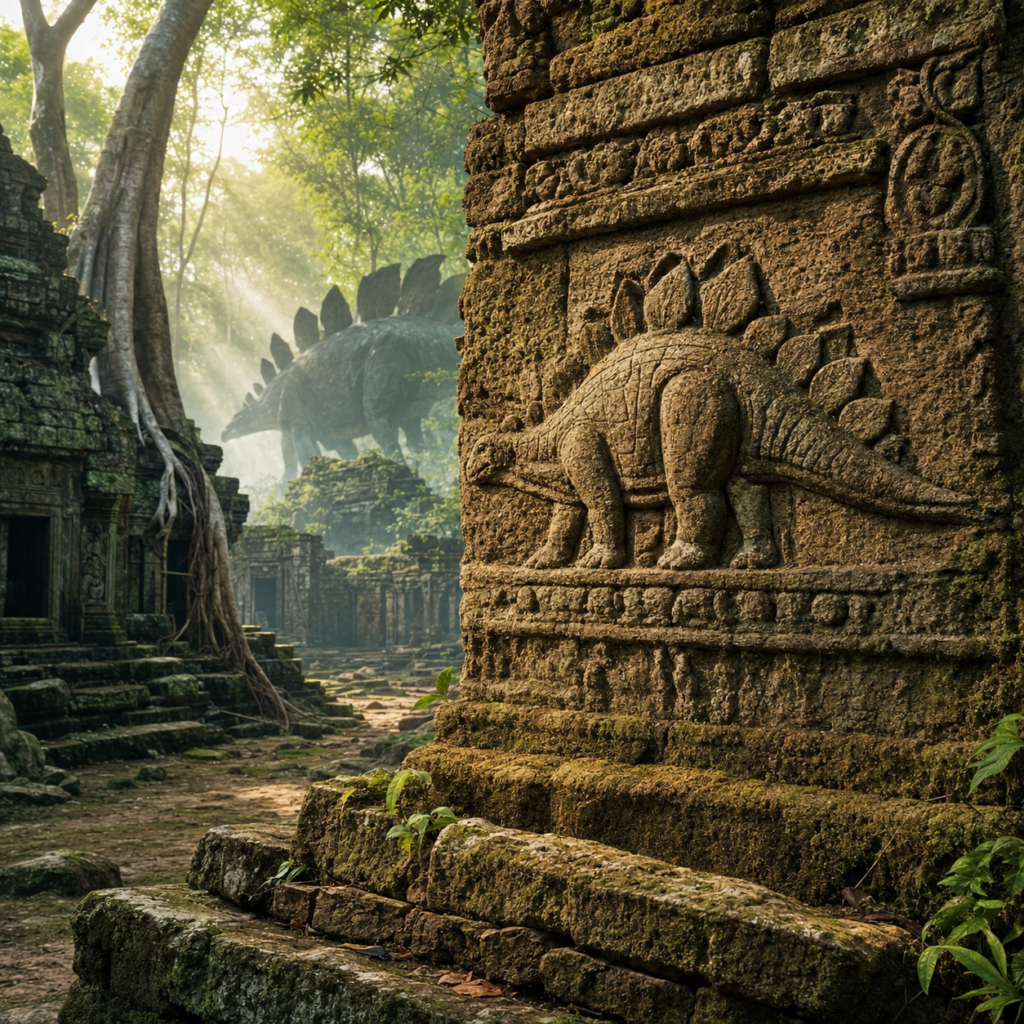
The Ta Prohm Stegosaurus exists as discussed by the characters in this book. Of course, lots of people say it looks like a wild boar, or a cow with a funny-looking face, while others claim it was added later as a joke. Although these possibilities might be true, I think it’s much more fun to let the imagination take over. I’m not suggesting that dinosaurs roamed the planet in the twelfth century, but tales of extinct beasts could have been handed down through the generations to people at that time. Compare this, if you will, to our modern myths surrounding dragons. We’re all pretty certain that dragons don’t exist right now, but creatures that looked a bit like them might have roamed the planet at some point, or they’re an amalgamation of several creatures combined. Either way, to say that it’s a wild boar that’s not up to the standard of the rest of the carvings, is missing the fun.
The chamber beneath Angkor Wat’s central lotus tower exists and is documented. It’s neither as vast, nor as grand as the one I’ve described in this story. The light well running down the center of the tower is there too. It’s designed with such precision that during the equinoxes, when the sun is directly overhead, a shaft of light shines directly into the chamber.
Some suggest this chamber was a mausoleum for King Jayavarman VII, who built the temple, although his remains aren’t there. Of course, his remains could have been removed in the intervening years, but the existence of the place raises some interesting questions for me, which I had fun exploring in this story.
To add further intrigue, Chinese diplomat Zhou Daguan, who visited Angkor in 1296, described temple vaults overflowing with royal treasures. Yet today, these fabled treasure chambers are either empty, or more excitingly, undiscovered. The treasure could have been looted by invading armies, moved by the Khmer kings themselves, or (my favorite theory) could lie somewhere undiscovered.
Much of what we know about Angkor during this time is thanks to Zhou Daguan, who spent nearly a year in the city and documented his observations. His account provides an invaluable glimpse into Khmer life, the architectural marvels, and the society that thrived there. Daguan was awestruck by Angkor Wat and described its grandeur as surpassing anything he had seen. He noted the intricate carvings, vast reservoirs, and impressive city planning. Beyond the temples, his writings shed light on the daily lives of the people, their social hierarchy, customs, clothing, and agriculture. His, remains one of the best accounts of life at the time.
Daguan vividly described the king’s divine status, the elaborate court rituals, and the bustling markets filled with goods from across the region. It was actually Daguan who reported that the Khmer king visited a golden tower at night to commune with a spirit. This spirit was believed to be the true source of the kingdom’s power, and if the king should miss this meeting, disaster would strike. Daguan reports that if the spirit failed to show up even once, it was an omen of the king’s imminent death. If the king himself missed the appointment, there was a national disaster coming. Some claim that Daguan made this up, or misunderstood what was going on, which could, of course, be true. Either way, this provided me with the idea for the Lotus Key, and how the king might use the relic’s power to communicate his wishes to the people. The truth behind what the Khmer King actually did every night in this golden tower we’ll never know, but we can imagine!
Even by the standards of today’s sprawling cities, the vastness of Angkor is awe-inspiring. Much of it is thanks to Suryavarman II, who expanded the empire to its greatest extent and then Jayavarman VII, who rebuilt the empire after the Cham invasion and constructed iconic temples like Bayon, Ta Prohm, and Preah Khan. We meet Jayavarman VII at the start of this book, on his deathbed, ready to pass the reins over to his son Indravarman II. Although Indravarman ruled for over twenty years, there is very little recorded information about him—it’s almost as though he’s been erased from history.
Historians think that his successor, Jayavarman VIII, systematically destroyed records of Indravarman’s reign in something of a coverup. In fact, only a single inscription survives to tell us he died in 1243, leaving everything else a mystery. Indravarman II’s “disappearance” from history might be linked to something deeper than royal rivalry. As a devoted Buddhist ruler following his father’s footsteps, he faced a kingdom increasingly pulling back toward Hinduism. When Jayavarman VIII took power, he led an aggressive Hindu restoration, potentially explaining his attempt to erase his Buddhist predecessors from memory.
Although Indravarman’s reign was peaceful, the empire was now in decline. The Khmer grip on Champa slipped away, and the rising Sukhothai kingdom carved off western territories. The rest, as they say, is lost to history. Or maybe he took the Lotus Key out of the temple and without that power, the empire disintegrated. It fits, doesn’t it?
After a week in Siem Reap, which is the modern city closest to Angkor Wat, Mrs. R and I traveled to the capital city, Phnom Penh. A thriving, vast and noisy place, Phnom Penh is currently in the midst of incredible growth. I expect that within ten years, with all the foreign investment it’s receiving, it’ll rival Bangkok or Singapore as an international hub.
Preferring less chaotic places, we quickly moved on to the island of Koh Rong. Although we initially planned to spend only a few days on the island, we were so captivated by its charm that we ended up staying for nearly two weeks. We made our temporary home in a secluded beach hut, two hundred yards from a bar that served cold beer and barbecue food late into the night. Our only company was a family of monkeys that lived in the trees. If there’s a better place to spend a few days, I’ve not yet found it. It was there that I decided, in some small way, Eden should visit the island. Although Koh Rong isn’t central to the story, it was important to me that it got an honorary mention in the early pages of this book.
Not far from Koh Rong lies the Bokor Hill Station where Mei-Ling Zhao based her nefarious operations. As described in the story, Bokor was built by French colonists in the 1920s. The site was envisioned as a luxury retreat to escape the sweltering heat of the lowlands. The centerpiece, the grand Bokor Palace Hotel & Casino, which once hosted Cambodia’s elite in art deco splendor, is now an empty ruin. An abandoned church stands nearby and the old post office, police station, and royal apartments are also frozen in time. The whole area was deserted during Cambodia’s wars and the Khmer Rouge insurgency in the late 20th century. The eerie, mist-shrouded ruins have since drawn tourists, artists, and filmmakers. Unfortunately, we didn’t make it here on this trip, but next time it’s top of the list.
As you may know, I share a lot of the facts and legends that go into my stories on social media. Whilst I love creating these, and get loads of positive comments, I also get a few negative ones too.
Here are three that caught my eye this week:
This is utterly stupid and is frankly offensive. Try promoting real history and archaeology instead of fantasy and nonsense.
Whenever i tell myself to try to be nicer on the internet someone posts something as stupid as this and then i see the insanely stupid people in the comments saying it’s a stegosaurs.
Welcome to idiotville Who’s excuse investment! As alexa says, you’ve been exiled here for some kinda punishment! Since someone put a symbol in front of your creations you’ve been Imprisoned ever since. Funding others amusement!
(I’ve left the spelling mistakes to illustrate the level of madness we’re dealing with here!)
I want to say now, to let it be known, I am not a historian, archaeologist, or scientist—I’m a storyteller. I tell tales about things that interest me, and I hope they’ll interest you too. Sometimes the subjects of my books pose interesting questions by contradicting the mainstream narrative. If someone’s offended by this, or takes this too seriously, then that’s on them. These negative comments make me want to work harder to reach more people who are interested in the things I have to say.
I don’t promise that my stories are true, instead I strive to make them fun, exciting and bring joy to those who are open to them. Life can be challenging so if you—or anyone—finds a moment of escape within the pages of my adventures, then it’s all been worthwhile. I also love my books to ask questions, like:
“Where do we draw the line between free will and peace?”
Or:
“How did a civilization with only primitive tools build a structure as vast and grand as Angkor Wat?”
Or:
“Is it possible that we don’t have everything worked out yet?”
It’s also important to me that my writing sheds light on things which I don’t think should be ignored. The so-called re-education camps in China’s Xinjiang region that are mentioned in this book, for example. Although we didn’t visit this place on screen—I was compelled to highlight this issue in the background.
The Uyghur people are a predominantly Muslim ethnic group who live primarily in the Xinjiang Uyghur Autonomous Region in northwestern China. In recent years, reports have surfaced of mass detention and surveillance targeting Uyghurs in Xinjiang. Human rights organizations estimate that over one million Uyghurs, along with other Muslim minorities, have been detained in so-called ‘re-education camps.’ Officially, the Chinese government refers to these facilities as vocational training centers aimed at combating extremism and fostering economic opportunities. However, leaked documents, survivor testimonies, and satellite imagery reveal a different reality.
The international community has responded with sanctions, calls for investigations, and increased awareness campaigns. However, China’s significant global influence complicates efforts to address these human rights abuses, leaving the Uyghur people in a precarious situation.
I also wanted to raise awareness of Cambodia’s stolen works of art. While walking through the temples today, it’s sadly all too common to see the feet of statues remaining, with the rest having been hacked off and sold. While the country suffered under a brutal dictatorship, carvings and ceremonial artifacts were taken from sacred sites across the region and are now in private collections or museums around the world.
Cambodia is now fighting back with a national campaign to recover and repatriate these relics. A team of archaeologists, investigators, and legal experts are working to trace, document and repatriate the country’s stolen treasures. Many major museums and private collectors are being forced to confront the provenance of their acquisitions, and several have already returned artifacts to their rightful homes.
These stolen artifacts are not the only haunting remnant of the conflict that once tore the country apart. Even after decades of peace, Cambodia remains one of the most heavily landmine-infested countries in the world. For many Cambodians, parts of their villages remain off limits for fear of unexploded devices.
The densest concentration of mines exists in the northwestern regions near the Thai border (where Eden and her crew visit) with significant numbers around temple complexes that once served as military strongholds. Brave men and women painstakingly clear the ground inch by inch using metal detectors, trained animals, and mechanical de-mining machines, saving lives and restoring safety to communities.
While in Cambodia, we visited an exhibition on how this continues to plague the poorest communities. Inspired by what we saw, we will support the Landmine Relief Fund in 2025. Although there are several charities who do great work in this area, this is the one who runs the museum we visited. In addition to removing the mines, they work with an organization that has built nearly 50 schools on or near old minefields. This means that a small percentage of the money you paid for this book and my other books will end up improving the lives of people in the area that inspired this story. Should you be interested you can see the work the Landmine Relief Fund do on their website: https://www.landmine-relief-fund.com/
Although Eden remains the protagonist in the book, I enjoyed exploring Athena’s character a little more within these pages. It was fun to dig through her past and have Mei-Ling Zhao arrive on the scene. Throughout the series, I’m enjoying exploring various characters and their relationships with each other.
As I write this, looking into 2025, I’m thinking about the next adventure both for me and Eden. I’m going to take a short break from this series and work on a couple of new projects in the first months of the new year. Don’t worry, Eden Black and the rest of the crew will return toward the end of 2025. What that adventure will look like, we’ll all have to wait and see!
Once again, thank you for your company and I can’t wait for our next adventure together.
Luke
December 2024.
I write books that blend history, adventure, and suspense, taking you on a journey to foreign and exotic places like the Pyramids of Giza, the skyscrapers of Hong Kong, and the backstreets of Kathmandu. Whether you’re a history buff, a travel addict, or just looking for excitement, my stories are for you.