This article is based on an episode of The Adventure Story Podcast, where I chase legends, uncover history, and ask the questions that sometimes get ignored. Listen below, or wherever you get your podcasts.
In 1926, a slim book appeared in a handful of Paris bookshops. It claimed that the great Gothic cathedrals of France were never just places of worship. They were books carved in stone, hiding the secret of alchemy. Its author called himself Fulcanelli. A century later, nobody has proved who he was, and by the time his first readers turned the pages, he had vanished.
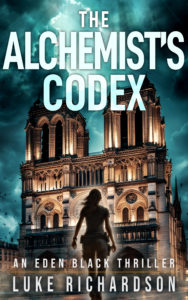
It’s a mystery I’ve lived with for the past year, because it sits at the heart of my new novel, The Alchemist’s Codex.
Fulcanelli is the pen name of a French alchemist who wrote two books: Le Mystère des Cathédrales (The Mystery of the Cathedrals, 1926) and Les Demeures Philosophales (The Dwellings of the Philosophers, 1930). His real identity has never been established. He is one of the most enduring unsolved mysteries of the 20th century.
Even the name may be a clue. Many readers see Vulcan in it, the Roman god of fire and the forge, joined with El, an ancient word for God. Together they suggest something like “sacred fire”. For a man who supposedly spent his life at the alchemist’s furnace, that feels rather fitting.
The book was published by a young man called Eugène Canseliet, who said he had been Fulcanelli’s student. In his preface he made an extraordinary claim. His master, he said, had completed the Great Work: the transmutation alchemists had chased for thousands of years. Then, rather than enjoy his success, Fulcanelli simply disappeared.
The illustrations came from the painter Julien Champagne, another member of Fulcanelli’s small and secretive circle. Between them, they produced a guided tour of Gothic architecture unlike anything published before. At its heart stands Notre-Dame de Paris.

When you stand in front of Notre-Dame, your eyes are drawn upwards to the towers, the rose window and the spire. Fulcanelli asks you to look down.
On the stone pillar that divides the central doorway, the Portal of the Last Judgment, there is a series of small carved medallions that most visitors walk straight past. One shows a woman seated on a throne, her head reaching into the clouds. She holds a sceptre. In front of her lie two books, one open and one closed, and a ladder rests against her body.
Fulcanelli was convinced this was the figure of Alchemy herself. The open book stood for knowledge anyone could see; the closed book for the secret kept for those who knew how to read it. The ladder represented the patience the work demanded, climbing towards the truth one rung at a time.
Work your way across the façade, reading the ravens, lions, dragons, kings and salamanders, and Fulcanelli finds every stage of the alchemical process. By the time he’s finished, the cathedral has become a laboratory manual, hidden in plain sight and carved by medieval craftsmen who, if he was right, knew exactly what they were doing.

Four years later, The Dwellings of the Philosophers applied the same reading to mansions and chapels across France. After that, Fulcanelli fell silent.
To understand why Fulcanelli caused such a stir, you have to go back to a legendary alchemist who walked the same streets 500 years earlier. Unlike Fulcanelli, there’s no doubt this man existed. His name was Nicolas Flamel.
Flamel was a scribe and bookseller in 14th-century Paris, working around the church of Saint-Jacques-de-la-Boucherie. He married a woman named Perenelle, and records show the couple became surprisingly wealthy, so wealthy that they funded churches and hospitals across the city. Which raises the obvious question: where did the money come from?
Around two centuries after his death, a book appeared claiming to answer that question in Flamel’s own words. According to this account, he bought a strange, ancient book for a couple of florins and spent years failing to decode it. Then, on the road home from a pilgrimage to Santiago de Compostela, he met a scholar who helped him unlock its secrets. In 1382, the story goes, Flamel performed his first transmutation, turning mercury into silver and then into gold.
Historians are fairly confident the account was written long after Flamel’s death by someone borrowing his reputation. But the legend took on a life of its own. His tomb was said to have been opened and found empty, and for centuries travellers claimed to have met Flamel and his wife alive and well in distant corners of the world.

So when Fulcanelli came along, writing about the same city, the same stories and the same Great Work, people couldn’t help seeing a pattern: another man with a fortune in secret knowledge, another figure who seemed to slip out of his own time. Some even suggested, only half joking, that Fulcanelli and Flamel were the same man.
If the books were where the Fulcanelli legend began, Canseliet’s stories turned it into something much bigger.
Canseliet claimed that in 1922, in a laboratory at a gasworks just north of Paris, he personally carried out a transmutation using a tiny amount of powder Fulcanelli had prepared. He said it turned around 100 grams of lead into gold in front of witnesses, Julien Champagne among them.
Then things took a stranger turn. In 1937, the young chemist Jacques Bergier, assistant to the atomic physicist André Helbronner, said a stranger approached him in his Paris laboratory with a message. Scientists, the stranger warned, were getting dangerously close to releasing the forces locked inside the atom. Weapons could be made from a few grains of metal, powerful enough to wipe out entire cities. Humanity, he suggested, had done this once before and paid a terrible price.
Bergier believed for the rest of his life that the stranger was Fulcanelli. After the atomic bombs fell on Japan in 1945, he said American intelligence officers came to ask whether he knew where Fulcanelli could be found. He couldn’t answer.
There was one final sighting. Canseliet said that in 1953 he met his old master again, in Seville. By then Fulcanelli should have been a very old man, yet Canseliet described him as looking younger than at their last meeting. After that, the trail goes cold.
There’s no shortage of candidates, and none has ever been proven:
There’s one more detail. Canseliet claimed Fulcanelli wrote a third book, Finis Gloriae Mundi (The End of the World’s Glory). It was handed over for publication, and then, just before it could be printed, Fulcanelli took it back. Nobody knows what was in it or why he decided the world wasn’t ready. As far as anyone knows, the manuscript has never been found.
A book with that title did appear in 1999, sent to its editor, it was claimed, by email from an anonymous source. Most experts dismiss it as a fake.
Which leaves one question I can’t answer: what was so dangerous that even Fulcanelli wouldn’t share it?
That question is what sparked my new book. Earlier this year, Mrs R and I set off in our camper van on a long research trip around France. We stood in front of those medallions at Notre-Dame, wandered the old streets where Flamel lived and worked, and followed the trail of carvings Fulcanelli wrote about a century ago.
Somewhere along the way, a question took hold of me and wouldn’t let go. What if Fulcanelli really did know something? And what if someone today was willing to do anything at all to find it?
That’s where Eden Black comes in. In The Alchemist’s Codex, the eighth book in my Eden Black archaeological thriller series, Eden is drawn into the shadowy world of Parisian alchemy, where Fulcanelli’s secret turns out to be far more than a historical curiosity. The clues are hidden in the stone, the stakes couldn’t be higher, and the people chasing them will stop at nothing. (You can read more about the book in The Alchemist’s Codex Is Out Now.)
Unlike Fulcanelli, it’s easy to find. Get The Alchemist’s Codex here.

Fulcanelli was the pseudonym of a French alchemist who wrote The Mystery of the Cathedrals (1926) and The Dwellings of the Philosophers (1930). His real identity remains unknown. Suggested candidates include the painter Julien Champagne, his student Eugène Canseliet and the physicist Jules Violle.
It argues that the sculpture of Gothic cathedrals, especially Notre-Dame de Paris, encodes the stages of alchemy, so that the buildings can be read as manuals of the alchemical Great Work.
It’s a small carving on the central pillar of the Portal of the Last Judgment. It shows a seated woman with a sceptre, an open book, a closed book and a ladder. Fulcanelli identified her as the figure of Alchemy.
Flamel was a real 14th-century Paris scribe who became very wealthy. The account of his transmutation was most likely written around two centuries after his death by someone borrowing his reputation.
Yes. His house at 51 Rue de Montmorency, built in 1407, is often described as the oldest stone house in Paris. His tombstone is in the Musée de Cluny, and the Tour Saint-Jacques stands nearby.
It’s Fulcanelli’s reported third book, which he withdrew before publication. The original manuscript has never been found. A book with that title published in 1999 is widely considered a fake.
Want more adventure? Join the Adventure Society, my weekly newsletter, to travel with me around the world and be first to hear when a new story drops. And subscribe to the Adventure Story Podcast wherever you listen.