This is the author note, which is published at the end of the book. It’s my chance to pull back the curtain a little and tell you what parts of the story are true, and where I’ve taken dramatic liberties. As a world traveller, I love bringing real places, cultures and history into my stories, and I feel it would be a mistake not to share the truth with you.
Be aware, there are spoilers here! I’d suggest you don’t read this until you’ve finished the book.
Order your copy of the book here.
Thank you so much for joining me on Eden’s seventh adventure, The Sahara Event. As with all my books, I had so much fun writing this, a fact that I hope came across in the twists and turns of the story.
Now at the seventh book in the series, I often get asked if I have plans to bring the series to a close. The answer is… no. I’m enjoying hanging out with Eden and her ever-changing band of heroes so much that I already can’t wait to get back into writing the next one. That doesn’t mean I won’t work on other books between Eden releases, though. I have so many other ideas that I want to bring to the page, and of course share with you.
Writing these author’s notes has always been one of my favorite parts of the process, as it’s my chance to talk to you directly. First, thank you for buying this book—in doing so you’re supporting me and my family in leading a life that brings us a lot of happiness. In fact, as I write this, Mrs. R and I are in our campervan enjoying the countryside for a few days. This certainly wouldn’t be possible without the support of readers like you.
The inspiration for the Sahara Event struck me while visiting Marrakesh, Morocco, in January 2025. As with all my ideas, I didn’t know that it would arrive when it did. In fact, at the time I was taking a couple of weeks away from the keyboard having just finished The Lotus Key. But the idea charged in anyway, and once it materialized, I knew it was too good to ignore.
Marrakesh itself is perfect fodder for an archaeological thriller writer like me—the twisting alleyways, bustling squares, and dark corners, much of which hasn’t changed in centuries.
But it’s not just the atmosphere that I found captivating; it’s the layers of history literally built on top of each other. An example of this, which inspired the secret network of tunnels through which Hamid guides Eden and the crew, are the Saadian Tombs.
This beautiful necropolis, the final resting place for members of the Saadian Dynasty in the 16th and 17th centuries, was “discovered” in 1917 when French officers conducting an aerial survey noticed a patch of land hidden between buildings. Intrigued, they sent a team to investigate. Breaking through the blocked entrance, they found ornate marble tombs carved with flowing Arabic calligraphy, mosaic covered pillars, and cedarwood ceilings in deep reds and blues.
The story goes that after the fall of the Saadians, Sultan Moulay Ismaʿil of the succeeding dynasty sought to downplay his predecessors’ legacy. Rather than destroying their burial site, he had the entrance to the necropolis sealed off, cutting it off from public view. Over time, the tombs slipped from memory, hidden behind the walls of the surrounding buildings.
Visiting the tombs, and learning the story behind their re-discovery, I couldn’t help but imagine what it would have been like to break through that wall and find all those spectacular rooms. Such stories catch my imagination and make me question—if the Saadian dynasty’s final resting place could vanish from memory, what else might be waiting down there?
But, as the twists of this story suggest, the idea fully took hold while exploring the passageways and courtyards of the Ben Youssef Madrasa. The walls of which are covered in tiles, arranged in a distinct quasi-crystalline pattern.
Researching this pattern later, I learned that it conforms to a mathematical principle—called aperiodic tiling or Penrose tiling—which wasn’t ‘discovered’ by Western mathematics until the 1970s. Yet here were medieval craftsmen, working hundreds of years ago, creating quasi-crystalline patterns using nothing but traditional tools and inherited knowledge.
Even more intriguing, when scientists finally understood quasicrystals in the 1980s (work that won the 2011 Nobel Prize), they realized these patterns appear in nature at the atomic level. These Islamic artisans somehow coded a fundamental structure of the universe without microscopes or computers, displayed it for all to see on the walls of the madrasa.
Of course, in these pages I imagined these patterns weren’t merely decorative, but a sophisticated code that preserved and transmitted ancient wisdom. Add to that the fact that similar patterns appear in Islamic architecture from Spain to India, and it sounds like a hidden network of knowledge transcending borders and centuries.
That brings us to the Eye of the Sahara—the crystal that plays a central role in the book. Although a crystal encoded with the secrets of a lost civilization might sound like a work of my imagination, the science behind it is surprisingly real. Quartz crystals are an essential component of today’s technology—every smartphone and computer relies on quartz to keep perfect time and synchronize data processing. Without quartz, the internet wouldn’t exist—fiber optic cables use it to transmit light signals across oceans. Even more remarkably, scientists now use synthetic quartz in quantum computers, where its crystalline structure can maintain quantum states at near absolute zero temperatures. Experts now think that data encoded into quartz, and kept in good conditions, could last a billion years.
Considering this, is it really a coincidence that some of the world’s most iconic ancient structures are built from quartz-rich stone?
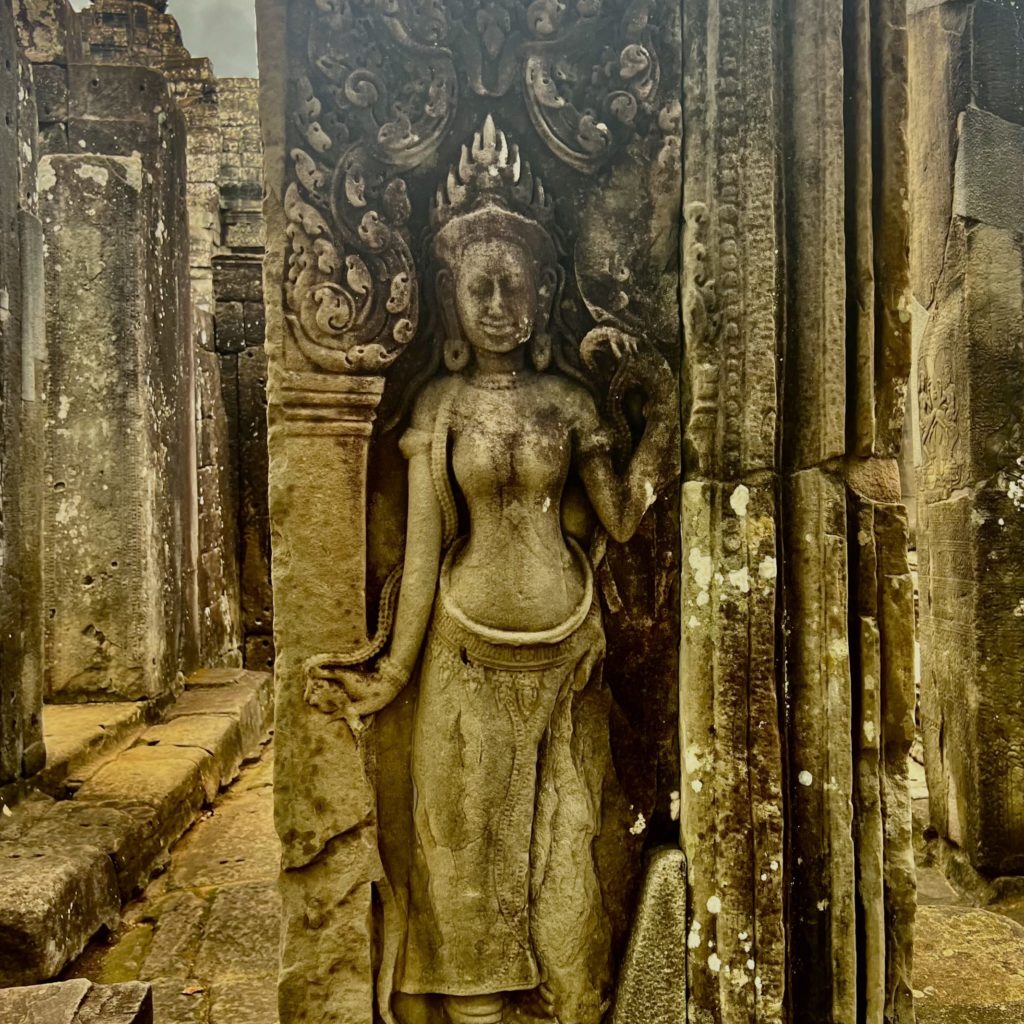
The inner chambers and sarcophagi inside the Pyramids of Giza, for example, are made from granite—a stone that typically contains between twenty and sixty percent quartz. Elsewhere in the ancient world, Angkor Wat is made of sandstone, which contains up to ninety percent quartz and the megaliths of Stonehenge are a mix of sarsen (a silcrete packed with quartz) and bluestone.
Across continents and civilizations, builders gravitated—perhaps unconsciously or maybe purposefully—toward stones that contained this magic mineral. If quartz can store data for billions of years, and ancient builders deliberately chose quartz-rich stones for their most sacred structures… were they trying to tell us something?
In terms of the story you’ve just read, it took me a while to decide what should be encoded on the crystal. At first, I went down a scientific route with the crystal containing the secret to stable antimatter production. This was a fascinating part of the story, which I enjoyed researching. In the end, however, I felt it was all a bit too technological.
I enjoyed the research, though, learning all about the atomic fossils, which I used in the opening chapters. Atomic Annie, as I called the fossil, was inspired by the natural reactor in Oklo, West Africa. Two billion years ago, in what’s now Gabon, nature created its own nuclear fission reactor, which ran for hundreds of thousands of years, self-regulating its chain reactions using nothing but natural uranium deposits and groundwater. When scientists discovered it in 1972, they couldn’t believe it—nature had beaten us to nuclear technology, and even solved its own nuclear waste problem, containing the radioactive byproducts in place for eons. Of course, there are experts who think such things are too coincidental to be purely a force of nature, but that’s a conversation for another day.
In the end, when the character of Dr. Alistair Irons emerged, I thought the idea of controlling the past was a much stronger and more interesting motive. After all, who wouldn’t want the chance to do that? Whether it’s to change something small—maybe betting on a race or knowing the questions on an exam—or something more meaningful, like reconnecting with a loved one, it’s a motive that I feel we can all understand. As always with the antagonists in my books, I feel it’s important we understand them and, in some way, see the method in their madness.
With all that said, let’s address the elephant in the room, and what a giant elephant it is… Could Atlantis really lie beneath the Sahara?
Well, as Yasmine Amana tells Eden in this story, the Romans certainly thought so. When Roman geographer Pomponius Mela created his world map in 43 CE, working from older documents, he wrote a single word in the desert (suspiciously close to the Richat Structure), Atlantae.
Mela wasn’t just doodling here—he was one of the Roman Empire’s leading geographical authorities, working from centuries of accumulated knowledge, much of which is now lost to us. His placement was deliberate and specific.
We also know for certain that the Sahara was once a green and verdant place. This isn’t speculation—this is scientific fact. Every twenty-thousand years or so, shifts in Earth’s axis cause the African monsoons to migrate north, transforming the desert into a lush savanna with lakes, rivers, and abundant wildlife. The last Green Sahara period ended around five thousand years ago—recent enough that early Egyptian hieroglyphs depict giraffes, elephants, and hippos living where there’s now only sand. Cave paintings in the Tassili n’Ajjer mountains show people swimming, hunting crocodiles, and herding cattle across grasslands.
What’s even more intriguing is that ground-penetrating radar has revealed massive ancient river systems beneath the Sahara, including one as large as the Nile running from the Mauritanian coast (near the Richat Structure) all the way to the Mediterranean. Called the Tamanrasset River valley, it’s now buried under sand but once supported thriving populations.
In the Sahara Event, I’ve taken these facts and asked: if advanced civilizations lived there during the time at which the Sahara was green, what happened to them after the desert took over?
The Richat Structure itself—the Eye of the Sahara—is exactly as I described in the book and remains genuinely puzzling to geologists. This massive bull’s-eye formation, forty kilometers across and visible from space, has characteristics that don’t quite fit any single explanation. It’s not a meteor impact crater, as originally thought. It’s not a simple volcanic formation. It has the famous concentric rings, the perfect circular shape, and its location near the Atlantic coast where Plato said Atlantis would be… well, it makes you wonder.
Unfortunately, I’ve yet to visit the Richat Structure, so had to rely on research for the scenes set there. If you have visited, I hope these parts of the story stacked up for you—I’d love to know what you thought!
Maybe I’ll get there on my next visit as the Sahara is certainly part of the world that I’ll visit again. There are enough legends to fuel a dozen books or more.
One of the most captivating of the Saharan legends is Zerzura—the Oasis of Little Birds. According to Medieval Arabic texts, this mythical white city is supposedly hidden somewhere in the Western Desert. Described as a city of sleeping kings and queens, and guarded by giants, the buildings are said to be made of white stone and filled with treasures beyond imagination. The city appears and disappears like a mirage, revealing itself only to those deemed worthy.
This legend was compelling enough for an expedition in the 1930s to set out in search of Zerzura. Following the Kitab al Kanuz, a 15th-century Arabic treasure hunter’s guide, which gives cryptic directions to Zerzura, a team searched the desert with vehicles and aircraft. They found real lost oases and ancient settlements, proving civilization did once exist where there’s now only sand, but unfortunately, no Zerzura.
In my thriller, I’ve woven Zerzura into the Atlantis narrative—perhaps it wasn’t one lost city, but many, connected by a civilization that understood the Sahara better than we do today. Whether Atlantis, as described by Plato, lies beneath the sand, I don’t know for sure. But I’ll tell you this, I’m certain there’s a lot we still don’t know about that great sea of sand.
As you’ll have realized, this is a very personal book for Eden. Once I realized I could tie Morocco and the Sahara into the Atlantean legend, I knew it was time to pull that curtain back just a little.
I did worry that if you’re coming to this book without reading the rest of the series, some scenes might not fully resonate. But ultimately, I decided Eden’s self-discovery was too important to skip. If that’s the case for you, I suggest you grab the Ark Files right now and dive straight in—an adventure awaits!
Aside from my joy at spending time with Eden and her crew in this book, I loved some of the new characters. Hamid quickly became one of my favorites with his collection of wisdom one-liners. Whilst these phrases started off as a joke (I always like a bit of light relief in a story), I felt that he ultimately becomes the book’s link between the old world and new—the bridge between ancient wisdom and modern understanding.
As a writer of books set all over the world, it is my responsibility not just to honor the places in my stories, but the people too. I feel that some stories in the adventure thriller genre are built on the stereotype of the local people either being victims or bandits, outsmarted or saved by the strength and cunning of the European or American “savior.” I hope I’ve not been guilty of that in any of my books, and I will continue to work to make sure that’s not the case.
To counter that in this book, I wanted Hamid to be thoughtful, clever, and most importantly, to teach Eden (and perhaps me too) something along the way. I also loved coming up with all of Hamid’s phrases—a leopard crossing the desert arrives with the same spots.
To me, Hamid quietly demonstrates that we in the modern world don’t have all the answers. He proves to Eden, and us all, that indigenous knowledge isn’t primitive or less-than, but rather a different (and maybe even a deeper) form of understanding.
As to whether Eden and a certain young man will ever be totally open with each other, you’ll have to wait and see. One thing I know for sure though: they will be back, they will fight the forces of evil once again, and you’re invited along for the ride.
Once again, thank you for joining me on this adventure. A special thanks if you’re part of my Adventure Society—this group of readers really helps me keep motivated between book launches. If you’re not, you can join here (https://lukerichardsonauthor.com/adventuresociety). I reach out every week or so and would love to thank you personally for your support.
Thanks again. See you on the next adventure!
Luke 😀
November 2025